Destination guide · South India

A cultural guide
to Tamil Nadu.

Temple cities, coastal towns & living traditions.

Rupin Travels
Pondicherry · Chettinad · Thanjavur · Madurai
Tamil Nadu is one of India's oldest continuously inhabited cultural regions — shaped over centuries by powerful dynasties, temple traditions, maritime trade, classical arts, and a deeply rooted Tamil identity.

Across the state, architecture, music, literature, food, craftsmanship, and spirituality continue to remain closely connected to everyday life. This is not a region that keeps its history in museums. It lives it — in temple bells at dawn, in flower markets opening in the morning light, in devotional music drifting from open doorways, in rituals that have endured across generations without interruption.

Unlike destinations centred primarily around monuments or landscapes, Tamil Nadu is often experienced through rhythm and continuity.

What is most distinctive about Tamil Nadu is the quality of that continuity. The Tamil language — spoken by over 80 million people — is one of the world's oldest living classical languages, with a literary tradition stretching back more than two thousand years. The architecture, the music, the food, the temple rituals: all of it is part of a civilisation that has not interrupted itself.

This matters to the traveller because it changes what you are looking at. A gopuram — the towering gateway tower of a Dravidian temple — is not a relic. It is a working structure, maintained and inhabited, its festivals observed, its priests attending to it each morning as they have for a thousand years. To visit one is not to visit a museum. It is to enter something ongoing.

The cultural landscape of Tamil Nadu unfolds differently across each region. Four of those regions reward particular attention.
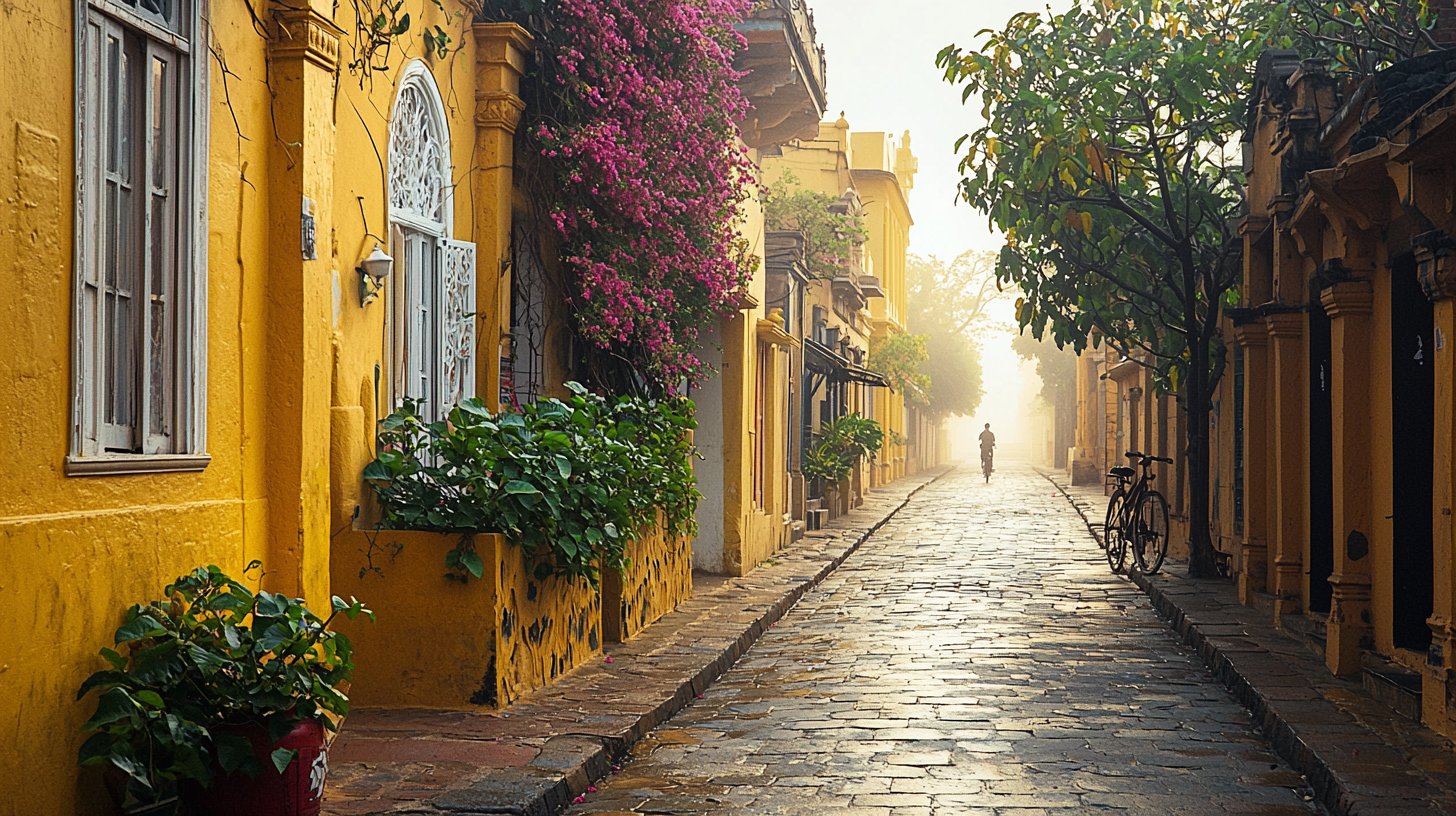
French Quarter street in Pondicherry with colonial-era buildings, bougainvillea and a sea-facing promenade

Pondicherry

The slower coastal rhythm.

Coastal town · Bay of Bengal

Pondicherry is one of South India's most distinctive destinations — a former French colonial capital on the Bay of Bengal where Tamil culture and European heritage exist in genuine, unhurried coexistence. Set along the coast, the city still retains quiet boulevards, colonial villas, churches, cafés, and sea-facing promenades that distinguish it from much of South India.

The influence of Sri Aurobindo and The Mother continues through the Sri Aurobindo Ashram and nearby Auroville, both of which have shaped Pondicherry's long association with philosophy, reflection, and alternative ways of living. The Ashram is best approached quietly, without agenda — its particular atmosphere of practice and intention is something that either lands or it doesn't.

Life here moves at a gentler pace. Mornings gather around the promenade; afternoons unfold slowly through shaded streets and cafés. The older Tamil quarters reveal another side of the city entirely — through markets, temples, and the texture of everyday local life that exists alongside the colonial quarter without competition.

Sri Aurobindo Ashram French Quarter Auroville Seafront at dawn Tamil quarters
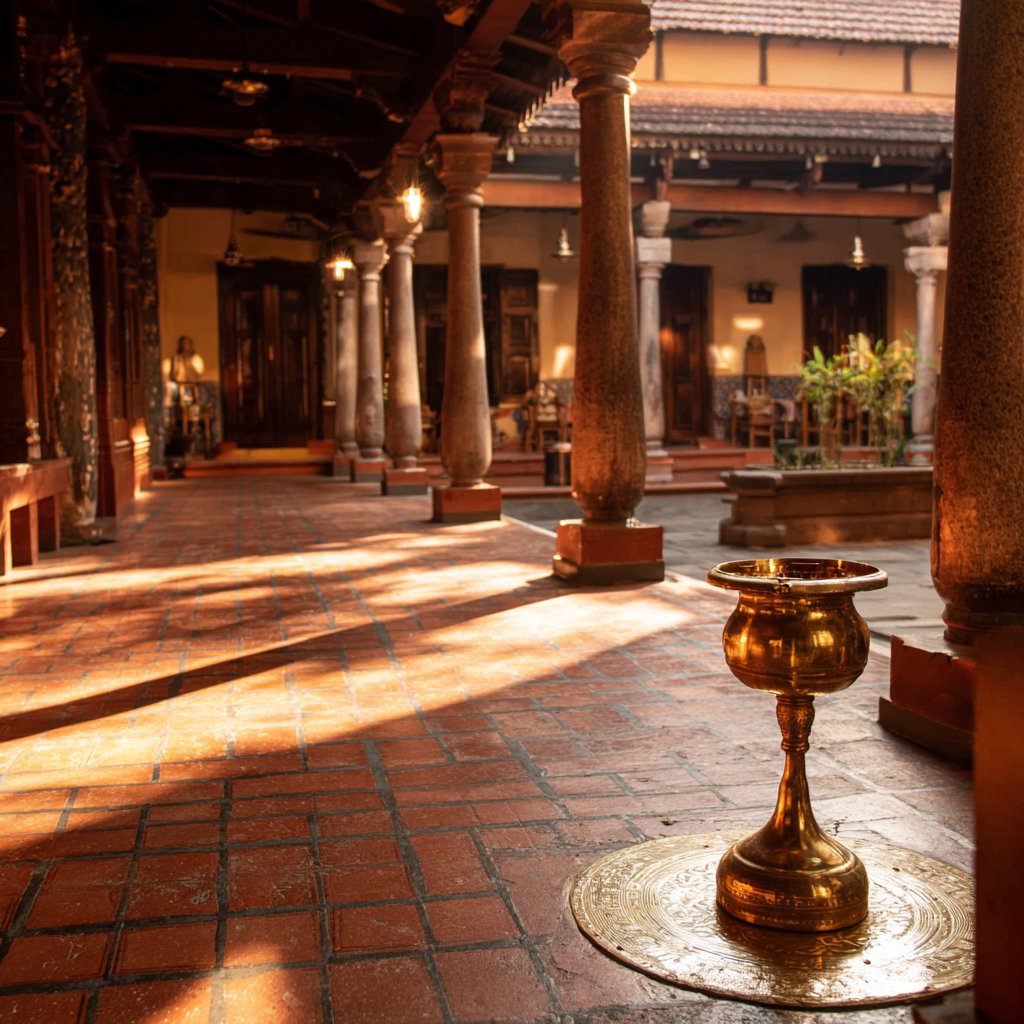
Grand Nattukotai Chettiar heritage mansion in Chettinad with ornate columns, Burma teak and Italian marble interiors

Chettinad

Craftsmanship, trade & heritage homes.

Interior region · Sivaganga district

Chettinad is among the most unusual heritage destinations in India — a cluster of villages in the Tamil interior whose grand Nattukotai Chettiar mansions, distinctive cuisine, and living craft traditions reflect a remarkable chapter of mercantile history. The region was once home to the Nattukotai Chettiars — influential traders and financiers whose business networks extended across South and Southeast Asia during the nineteenth and early twentieth centuries.

Their wealth and global connections shaped the grand mansions for which Chettinad is now known — vast ancestral homes built with Burma teak, Italian marble, and Belgian glass, whose interiors combine local craftsmanship with objects brought back from decades of trade in Burma, Sri Lanka, Singapore, and Malaysia. To stay in one is to sleep inside a specific chapter of Indian history that most travellers have never encountered.

Chettinad also remains closely associated with artisanal traditions — Athangudi tile-making, wood carving, weaving, metalwork — many continuing through family-run workshops. Its cuisine, known for layered spice profiles and slow cooking traditions, is among the most distinctive in all of South India.

Heritage mansions Athangudi tile-making Chettinad cuisine Craft workshops Village life
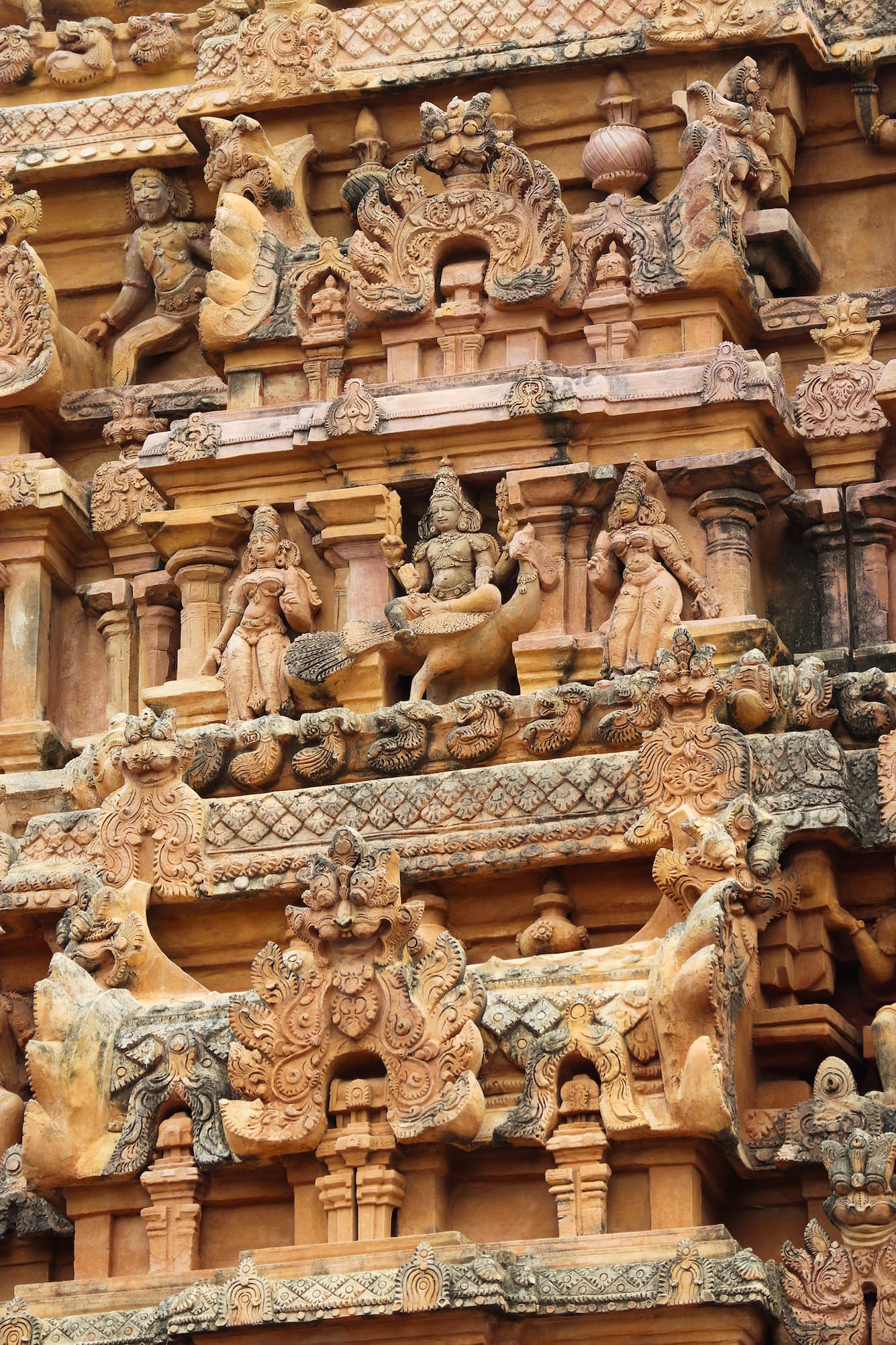
Intricate stone carvings on the Brihadeeswarar Temple gopuram in Thanjavur showing Chola-era sculpture and architectural detail

Thanjavur

The Chola legacy & sacred architecture.

Temple city · Cauvery delta

Thanjavur is the heart of Chola civilisation and home to the Brihadeeswarar Temple — a UNESCO World Heritage site and one of the greatest achievements of Indian temple architecture. The city emerged as one of South India's great cultural capitals during the reign of the Cholas, who ruled much of the region between the ninth and thirteenth centuries.

At the centre stands the Brihadeeswarar Temple, built in the eleventh century by Raja Raja Chola I. Constructed largely from granite, it remains one of India's most significant architectural achievements — known for its monumental vimana, inscriptions, sacred geometry, and intricate stonework. It is best visited early, before the heat, in the particular stillness the temple holds at dawn.

The Saraswathi Mahal Library — one of India's oldest surviving libraries — preserves manuscripts on philosophy, medicine, astronomy, and classical scholarship. The Royal Palace reflects the layered history of the Chola, Nayak, and Maratha periods through murals, bronzes, manuscripts, and royal artefacts.

Brihadeeswarar Temple Saraswathi Mahal Library Royal Palace complex Chola bronze casting Classical arts
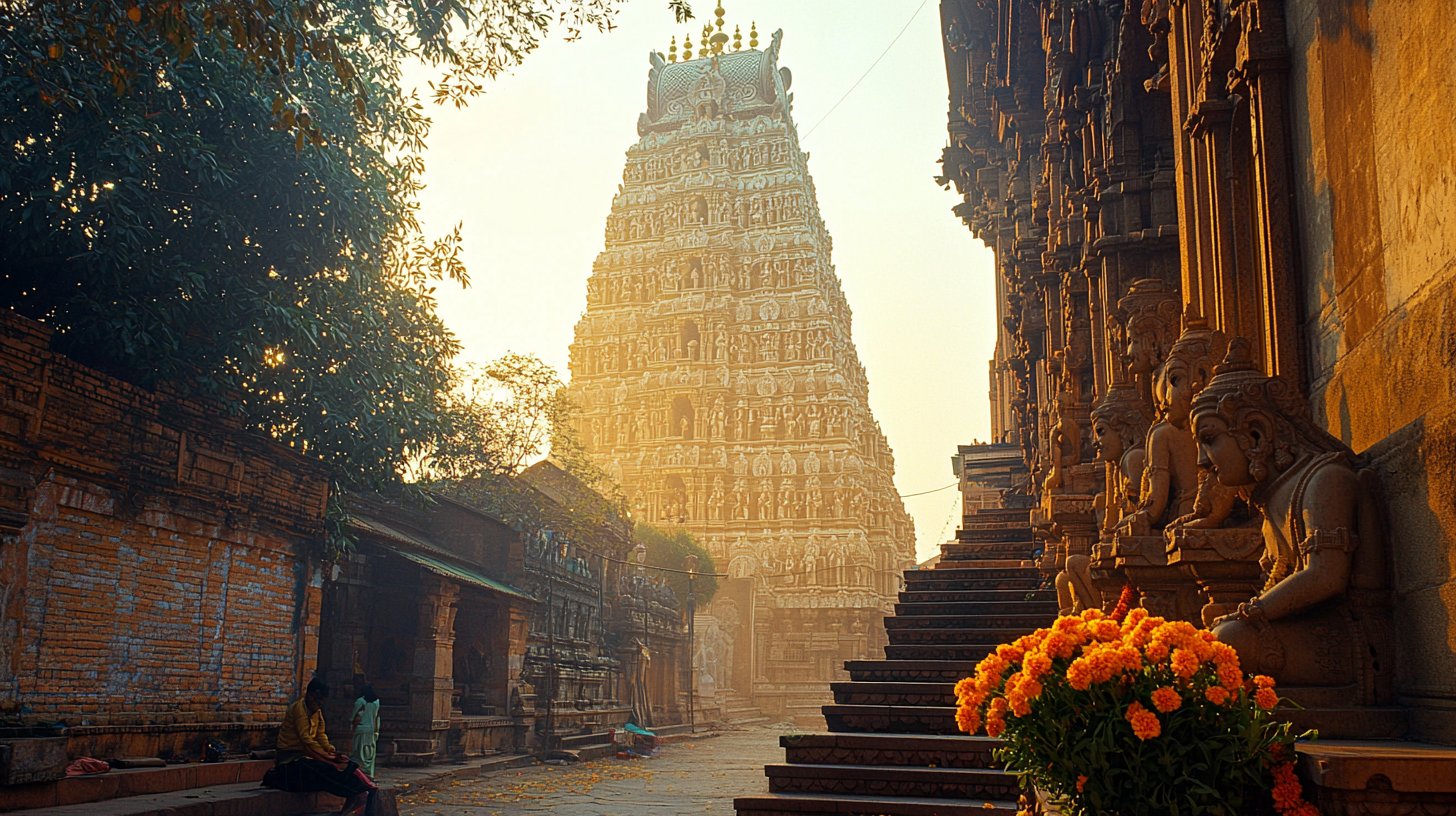
Meenakshi Amman Temple gopuram in Madurai at dusk, its towers covered in colourful sculpted figures rising above the old city

Madurai

The living temple city.

Ancient city · Vaigai river

Madurai is one of the oldest continuously inhabited cities in India and the spiritual heart of Tamil Nadu, centred on the Meenakshi Amman Temple — an active pilgrimage site whose fourteen towering gopurams draw devotees from across the subcontinent. Among Tamil Nadu's oldest cities, Madurai has long served as a centre of trade, literature, pilgrimage, and Tamil cultural life.

The Meenakshi Amman Temple forms the heart of the city — an active complex whose fourteen towering gopurams, carved corridors, rituals, and sacred spaces continue to draw pilgrims from across the subcontinent. Unlike many historic monuments preserved primarily for tourism, the temple remains fully woven into the rhythm of everyday Madurai. Its corridors hold pilgrims, flower sellers, priests, schoolchildren — all attending to something that has not changed in centuries.

Outside the temple, the city reveals itself through flower markets, crowded old streets, jasmine vendors, traditional eateries, and evening rituals that animate the old city. Madurai's atmosphere is defined less by monumentality than by the continuity of living traditions active across generations.

Meenakshi Amman Temple Evening aarti Old city flower market Thirumalai Nayakar Palace Tamil Sangam heritage

What connects these places
is not only history,
but continuity.

Together, these four regions offer different perspectives into Tamil Nadu's cultural landscape — from coastal philosophy and colonial history to temple architecture, mercantile heritage, sacred art, and devotional urban life. Each one is distinct. Each one asks something different of the traveller who arrives there.

Across cities, towns, temples, workshops, libraries, and homes — many of the traditions that shaped Tamil society centuries ago continue to remain part of daily life today.

This is what makes Tamil Nadu different from destinations where the past is preserved but separate — curated for observation, kept at a careful distance from the present. Here the past is not separate. It is the present. The same devotion that built Brihadeeswarar still tends it. The same craft traditions that furnished the Chettinad mansions still operate in village workshops nearby. The same rituals performed in Meenakshi Amman a thousand years ago are performed there tonight.

For travellers interested in architecture, craftsmanship, philosophy, music, literature, food, and living cultural traditions, Tamil Nadu offers one of the richest and most layered experiences anywhere in India — not because of what it has preserved, but because of what it has never stopped doing.

A few things worth knowing.

Best time to visit
October to February

After the monsoon, before the heat. Days are warm and clear. March through May grows punishing. June through September brings heavy rains to parts of the state.

Getting there
Fly into Chennai

Chennai International Airport connects to most major international hubs. Madurai also has domestic connections for those ending the journey there. Internal travel by private road transfer.

Pace & approach
Arrive slowly

Tamil Nadu rewards travellers who give places time. Fewer destinations, longer stays, no agenda beyond arrival — this is the approach that allows the region to offer what it actually has.

Soulful South.

11 days through Tamil Nadu's living temple culture — Pondicherry, Chettinad, Thanjavur, Madurai.
From $5,200 · Small group · South India.

View the journey Enquire

More from the collection.

Explore our destination guides to Uttarakhand, Kerala, and beyond — or write to us directly. Every question is answered personally.

 ·