Destination guide · North India

A sacred guide
to Uttarakhand.

Dev Bhoomi — the Land of the Gods.

Rupin Travels
Haridwar · Rishikesh · Kedarnath · Badrinath
Uttarakhand — Dev Bhoomi, the Land of the Gods — occupies a singular place in India's spiritual and cultural imagination. To travel here is to move through a landscape where the sacred is not confined to temples or rituals, but embedded in the rivers, the mountains, and the air itself.

Rising from the Gangetic plains into the high Himalayan valleys, Uttarakhand has for centuries drawn pilgrims, ascetics, philosophers, and seekers from across India and beyond. Some of Hinduism's most revered sites trace their origins here — the source of the Ganga, the Char Dham circuit of Kedarnath and Badrinath, the meditation caves of forest hermitages, and the ghats where river and ritual have met for generations without interruption.

Unlike destinations where spirituality is encountered primarily through monuments, Uttarakhand is experienced through landscape itself — rivers, altitude, weather, silence, and the gradual unfolding of the mountains above.

What makes Uttarakhand unusual among India's sacred regions is that its holiness is inseparable from its geography. Four places within Uttarakhand form the foundation of the Sacred Steps journey — each distinct in character, altitude, and spiritual significance.
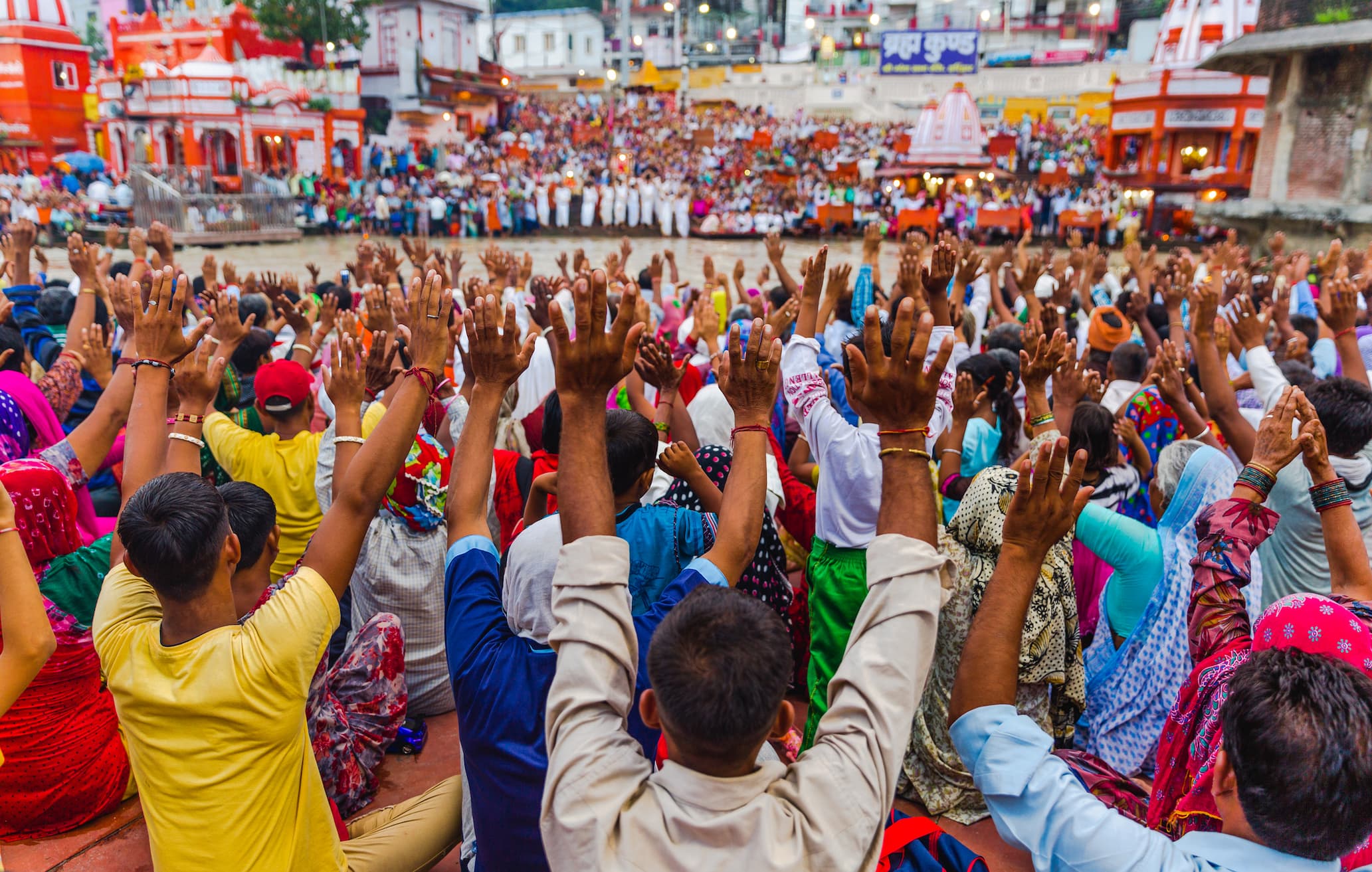
Crowds raising hands in prayer during the Ganga Aarti at Har Ki Pauri ghat, Haridwar

Haridwar

Where the Ganga enters the plains.

Pilgrimage city · Uttarakhand foothills

Haridwar is one of the seven sacred cities of Hinduism and one of India's most important pilgrimage destinations, drawing millions of devotees each year to the banks of the Ganga. Located at the precise point where the Ganga descends from the mountains into the northern plains, the city has for centuries served as one of India's most important pilgrimage thresholds.

The ghats here are the city's living centre. At Har Ki Pauri — whose name translates as the footstep of God — the evening Ganga Aarti unfolds each day as one of India's most enduring river rituals. Lamps are lit, chants rise, and offerings are set upon the moving water as the light fades.

Beyond the rituals, Haridwar reflects the full texture of North Indian pilgrimage culture — devotional music drifting from temple courtyards, wandering ascetics in saffron, river steps worn smooth by generations of footfall.

Har Ki Pauri ghat Ganga Aarti at dusk Pilgrimage ghats Devotional culture River rituals
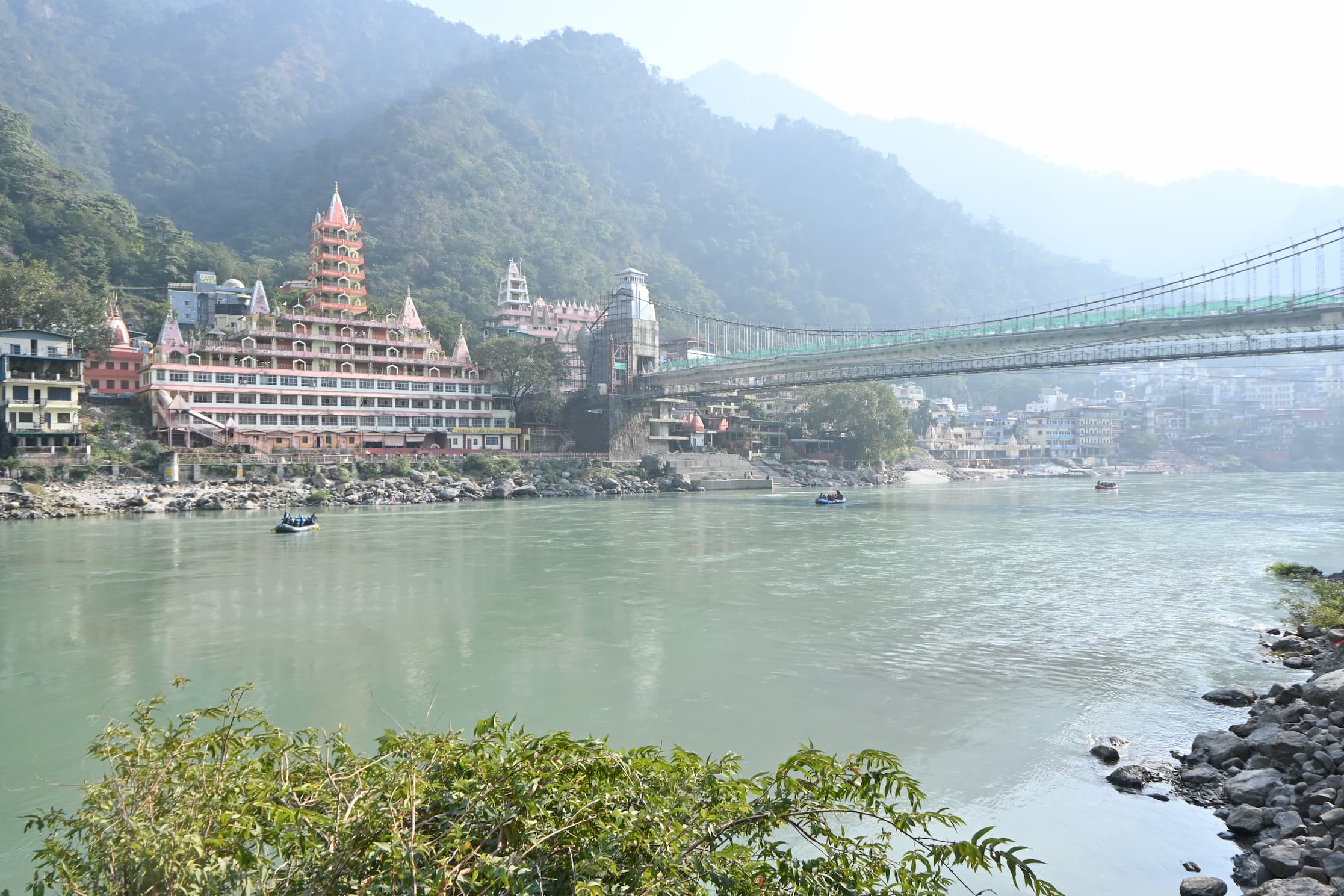
Laxman Jhula suspension bridge spanning the Ganga with temples and forested hills in the mist at Rishikesh

Rishikesh

Yoga, philosophy & the river valley.

Contemplative town · Garhwal Himalayan foothills

Rishikesh is widely regarded as the yoga capital of the world and one of India's foremost destinations for meditation, spiritual retreat, and Ayurvedic wellness. Surrounded by forested hills, with suspension bridges swaying across the river and ashrams built into the hillside, it has for centuries been associated with monastic learning and spiritual retreat.

Its deeper significance lies not in any single site but in its relationship to the river and the landscape. Mornings in Rishikesh are defined by temple bells, river mist, chanting, and the particular stillness that settles before the day's activity begins.

For the traveller seeking contemplative experience, Rishikesh offers something rare — a place where the infrastructure of spiritual practice is woven naturally into daily life, and where slowing down is a consequence of the environment itself.

Ashram retreats Yoga traditions Laxman Jhula River mist at dawn Monastic learning
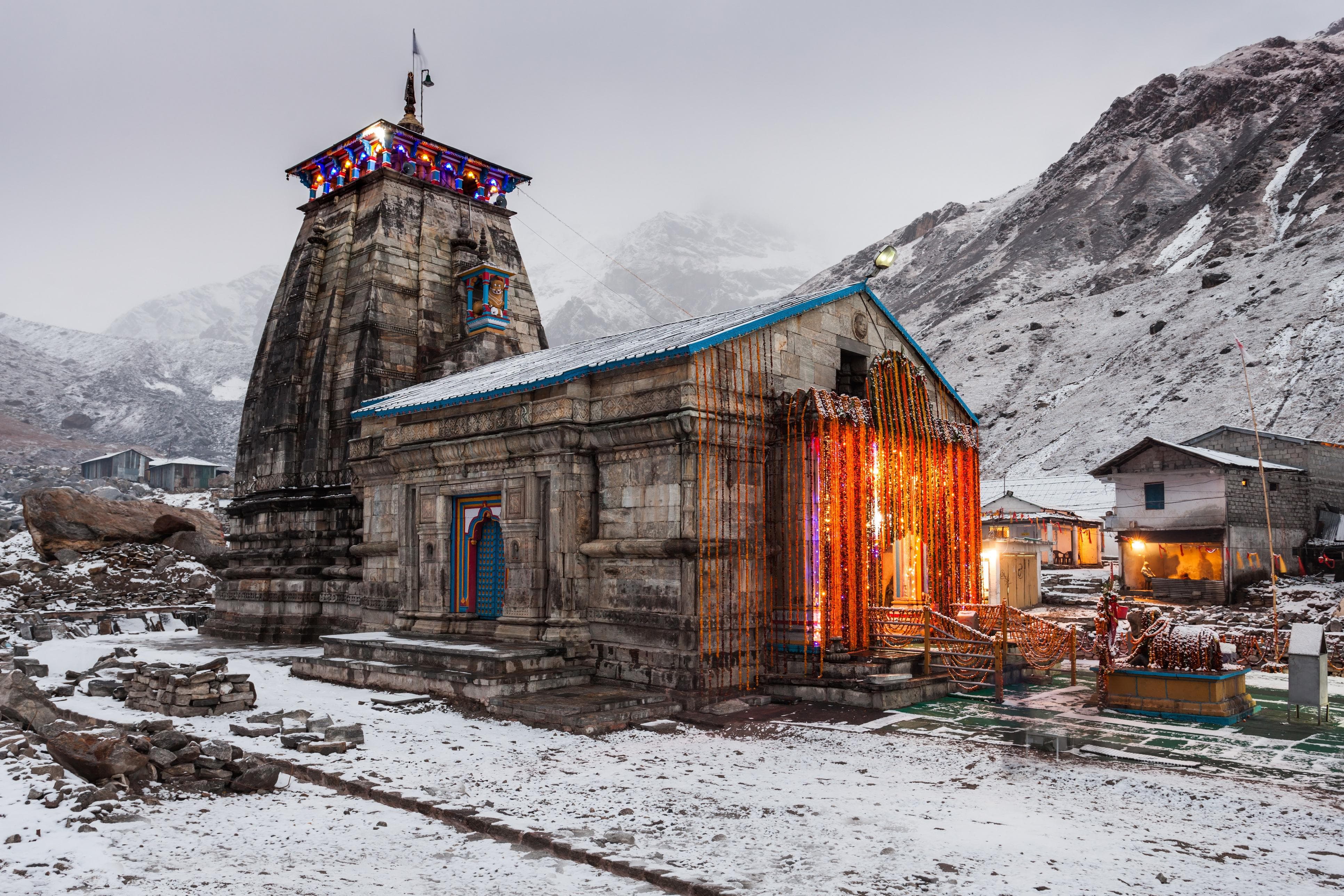
Kedarnath temple covered in snow with marigold garland decorations glowing against the glacial Himalayan peaks at dusk

Kedarnath

Pilgrimage in the high Himalayas.

3,583m altitude · Garhwal Himalayas

Kedarnath temple is one of the twelve Jyotirlingas and one of the most revered Shiva pilgrimage sites in India, part of the Char Dham circuit that draws hundreds of thousands of pilgrims each season. Situated above 3,500 metres in the Garhwal Himalayas, it is a site that has drawn pilgrims for over a thousand years.

The temple sits at the foot of glacial peaks in one of India's most dramatic natural settings.

Unlike the temple cities of the plains, Kedarnath is defined as much by what surrounds it as by the temple itself. The altitude, the cold, the changing weather, and the physical effort are not obstacles to the experience; they are the experience.

Mornings at this altitude open into vast, luminous mountain light. Clouds gather and dissolve across the valley with extraordinary speed. The temple appears and disappears within mist. Kedarnath is less about architecture than about scale, silence, and emotional intensity.

Kedarnath Jyotirlinga Glacial mountain setting High altitude pilgrimage Helicopter access Mountain light at dawn
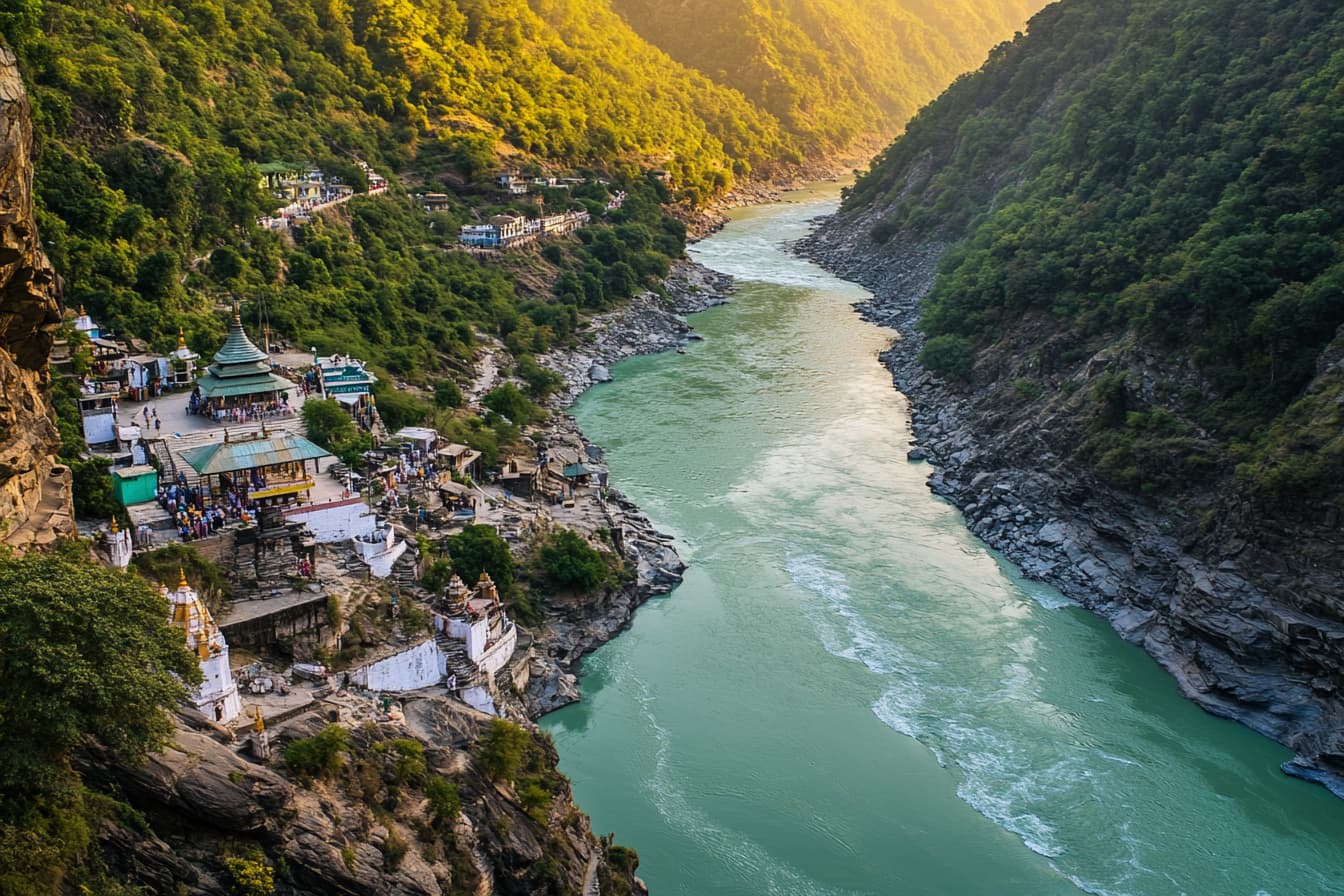
River confluence at Devprayag where the Alaknanda and Bhagirathi rivers meet, with temples on the cliff above the turquoise waters

Badrinath

Vishnu, mythology & the sacred valley.

3,133m altitude · Alaknanda valley

Badrinath is one of the most sacred Vishnu temples in India and a key site on both the Char Dham and Chota Char Dham pilgrimage circuits, receiving pilgrims from across the country during its six-month season. Located along the banks of the Alaknanda River, framed by the Nar and Narayan mountain ranges and the white peak of Neelkanth rising behind it, it is one of Hinduism's most revered destinations.

Badrinath carries a different quality from Kedarnath — where Kedarnath feels austere and physically demanding, Badrinath has an expansiveness to it. The valley is wider, the light cleaner, and the atmosphere more contemplative.

The mythological associations with Vishnu, Nar-Narayan, Vyasa, and the Mahabharata extend across the entire valley, connecting individual sites into a landscape that rewards slow, attentive exploration.

Badrinath Char Dham Alaknanda riverbank Neelkanth peak Mahabharata mythology Sacred valley walks

What connects these places
is not only altitude,
but ascent.

Haridwar, Rishikesh, Kedarnath, and Badrinath are not simply destinations on a route. They represent a progression — a movement from the edge of the plains into increasingly high, increasingly still, increasingly inward terrain.

Spirituality here is not separated from landscape. Rivers, altitude, weather, ritual, pilgrimage routes, and local traditions are not backdrops to experience — they are the experience itself.

Together, these places form one of the most profound spiritual itineraries in India — not because they are dramatic or photogenic, though they are both, but because they remain genuinely alive. These are not heritage sites preserved behind glass.

For travellers drawn to pilgrimage traditions, sacred geography, and the living continuity of Hindu devotional culture, Uttarakhand offers something that cannot be approximated elsewhere in India — a journey that asks as much of the body as it does of the spirit, and rewards both.

A few things worth knowing.

Best time to visit
May to June & September to October

The high Himalayan temples are open only between May and November. The windows either side of the monsoon offer the clearest conditions. The Sacred Steps journey departs in October.

Getting there
Fly into Dehradun

Jolly Grant Airport in Dehradun is the nearest gateway, with connections from Delhi and major Indian cities. Onward travel to Kedarnath and Badrinath is by private road transfer and helicopter.

Altitude & pace
Allow time to acclimatise

Kedarnath sits at over 3,500 metres and Badrinath at 3,133 metres. The journey is paced to allow gradual ascent and adequate time at each elevation.

Sacred Steps.

10 days through Haridwar, Rishikesh, Kedarnath, and Badrinath.
From $4,900 · Small group · Uttarakhand, North India.

View the journey Enquire

More from the collection.

Explore our destination guides to Tamil Nadu, Kerala, and beyond — or write to us directly. Every question is answered personally.

 ·